Action status
- Implemented
- Undergoing NMFS Review
- Approved by Council
- Under development by the Council
In November 2025, the Pacific Fishery Management Council (Council) scoped an action to revise the stock definition specified in the Coastal Pelagic Species Fishery Management Plan’s (CPS FMP) Fishery Management Unit (FMU; Table 1-1 in the CPS FMP).
The Council scoped this action to re-evaluate the FMU for sardine due to newly published research on the population structure of Pacific sardine, describing a single population ranging from the Gulf of California, Mexico, to British Columbia, Canada. This update in the science represents a departure from the long-held hypothesis that Pacific sardine off the West Coast of North America is comprised of two subpopulations and that only the “northern” subpopulation is exploited by the U.S. fishery.
Preferred Alternative – Stock Definition
In April 2026, the Council adopted Alternative 1 as the interim Final Preferred Alternative (iFPA) for the sardine stock definition in the CPS FMP’s FMU. Alternative 1 would amend the CPS FMP (Section 1.2, Table 1-1) to include all Pacific sardine in U.S. waters in the FMU. The FMU would include one stock of Pacific sardine, delineated coastwide. The selection of an iFPA is intended to provide a Council decision point to focus the further development of the action, which includes potential revisions to management provisions and reference points for sardine. Final action on the entire FMP amendment package is scheduled for November 2026.
Next Steps for This Action
Next steps to develop the holistic FMP amendment package will begin with a review of the key management provisions for Pacific sardine described in the CPS FMP (as outlined in Section 3.3 of Attachment 1) to determine if any of these reference points or other management criteria must be re-affirmed or revised. A revision of the stock definition should include consideration of the provisions of the Magnuson-Stevens Fishery Conservation and Management Act (MSA), the National Standards (NS) guidelines, and how they apply to the conservation and management of a revised stock. Outlined below are the provisions of the MSA and NS Guidelines, and the specific tools utilized for CPS and Pacific sardine to meet these requirements, that will be reviewed in the next steps of this action.
Timeline
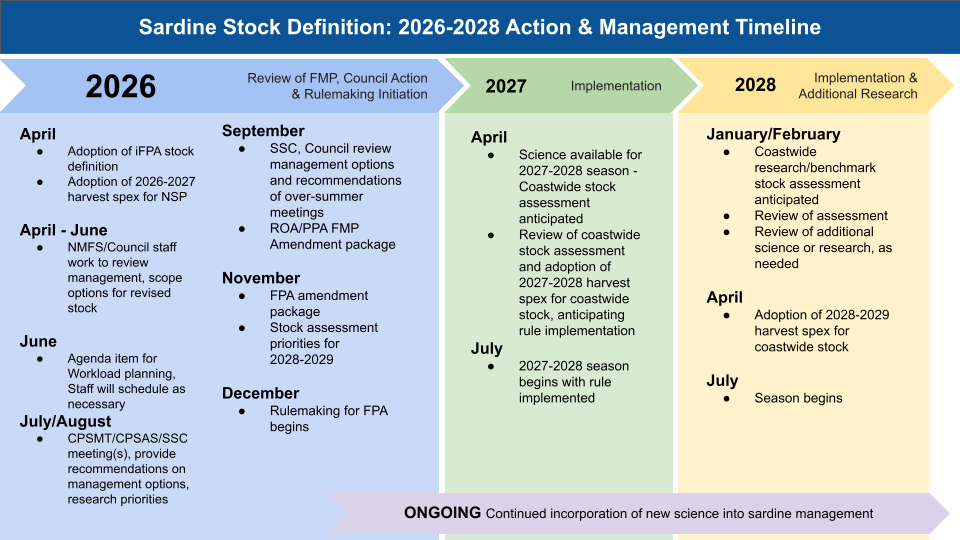
The following steps are anticipated to work towards final action:
1. Council and NMFS Staff review management criteria in the context of the iFPA
2. Council and NMFS Staff present management options for control rules and reference points, including parameters, as appropriate (i.e., re-affirming current value, recalculated value, or alternative approach)
3. Over-Summer meetings of the SSC/CPSMT/CPSAS/other advisors to review management options and make recommendations
4. Council scheduled to adopt an ROA and PPA for the amendment package in September 2026
5. Council scheduled to adopt an FPA for the amendment package in November 2026
6. Coastwide assessment and harvest specifications/management measures set for a coastwide Pacific sardine stock anticipated for 2027
These details follow the guidance provided by the Council in April 2026 and are outlined in the timeline below:
Review of Management Criteria
An overview of the management criteria, including the provisions of the MSA and NS Guidelines, and the specific tools utilized for CPS and Pacific sardine to meet these requirements, that will be reviewed in the next steps of this action was provided in the materials presented at the April 2026 Meeting (Attachment 1, Staff Presentation). They are summarized below.
MSA
The MSA establishes the required and discretionary provisions of FMPs. Notably, requirements include conservation and management measures and the specification of maximum sustainable yield (MSY) and optimum yield (OY), guidance on which is expanded upon in the National Standards.
National Standards
National Standard 1 – specifically addresses the MSA requirement to prevent overfishing and achieve OY. The Councils must evaluate and describe the items listed here in their FMPs
- Maximum sustainable yield (MSY) and status determination criteria (SDC)
- Optimum yield (OY) at the stock, stock complex, or fishery level and provide the OY specification analysis
- Acceptable biological catch (ABC) control rule
- Mechanisms for specifying annual catch limits (ACLs)
- Accountability measures (AMs)
National Standard 2 – criteria to consider when evaluating BSIA
National Standard 3 – defining the management unit as “the fishery or that portion of a fishery identified in an FMP as relevant to the FMP’s management objectives. Additionally, guidance for managing a transboundary stock such as Pacific sardine and its extent in U.S. waters
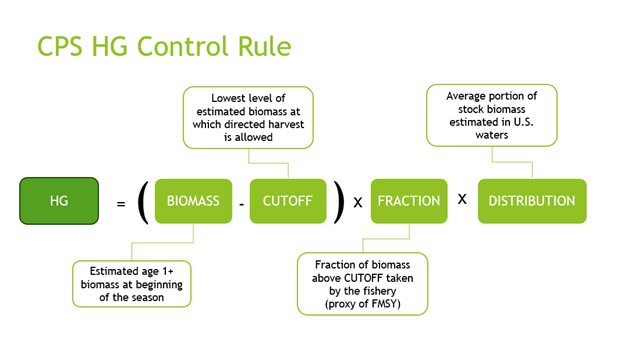
CPS Harvest Guideline (HG) Control Rule
The CPS FMP includes a harvest strategy and harvest control rules (HCRs) that intend to provide stock biomass levels at least as high as the MSY while also providing relatively high and relatively consistent levels of catch for the fishery. The particular HG approach was developed for CPS to account for their unique dynamics, including changes in biomass and productivity in response to environmental variability and their importance in the ecosystem as forage.
The purpose of the general HCR, is to provide managers with a tool for setting and adjusting harvest levels on a periodic basis while preventing overfishing and overfished stock conditions.” The general form of the HCR utilized for these CPS fisheries is designed to continuously reduce the exploitation rate as biomass declines.
Pacific Sardine Control Rules and Reference Points
Along with the CPS HG control rule, Pacific sardine management uses a variety of tools and measures to prevent overfishing and achieve OY. This includes setting annual reference points and management measures for the fishery based on the annual specification framework and control rules in the FMP. The Pacific sardine HG was originally developed in Amendment 8, and the control rules were revised in Amendment 13 to comply with MSA reauthorization and subsequent NS provisions. This included the development of an overfishing limit (OFL) and acceptable biological catch (ABC) control rule, as well as mechanisms for setting annual catch limits (ACLs) and annual catch targets (ACTs). These control rules and reference points wil be reviewed in the next steps under this action. The rules and reference points are outlined in the table below and described in depth in the text below the table. The parameters within each formula are described in depth in the next section, “Parameters.”

OFL – overfishing is defined for Pacific sardine as catch exceeding the OFL, based on the OFL control rule. The OFL is an annual catch amount that corresponds to the estimate of (annual) fishing mortality corresponding to MSY. In general, OFLs for CPS are based on an MSY or MSY proxy harvest rates (see the EMSY) which is applied to the best available estimate of biomass
ABC is set below the OFL (via application of the BUFFER) and is a reference point that incorporates a scientific uncertainty buffer against overfishing.
ACL is the level of annual catch of a stock that is set to help prevent overfishing from occurring. ACLs can then be set equal to or less than the ABC, and, in the case of a stock that is overfished and rebuilding, determined in accordance with the rebuilding plan.
HG and ACT – In cases where the result of the HG calculation exceeds the ABC, the Council will set a lower ACL, HG, or Annual Catch Target (ACT) in response. The ACT is also another management tool that is frequently used to prevent overfishing. CUTOFF is included at this stage (see the HG formula) to help protect the stock when biomass is low, reducing the exploitation rate as biomass declines. When sardine experiences periods of high biomass, the HG (and therefore harvest) is restricted to a maximum harvest level (MAXCAT) of 200,000 mt. While allowable harvest increases with increasing biomass, MAXCAT guards against extremely high catch levels.
Parameters
The Pacific sardine control rules and reference points include specific parameters will also be reviewed in next steps under this action. The formulas and parameters for each point are shown in the graphic below, with descriptions in the text underneath.

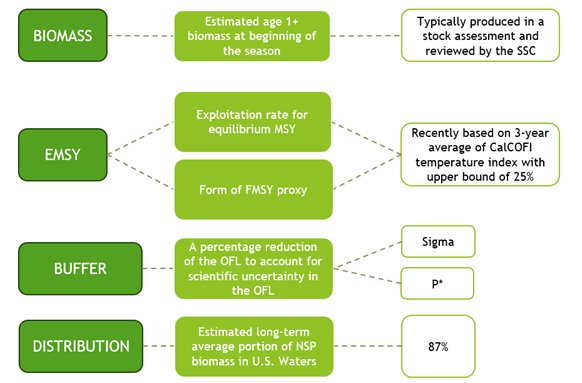
BIOMASS – The estimated stock biomass of Pacific sardine age 1+ for the applicable fishing year. This estimate is typically produced in a stock assessment and reviewed by the SSC
EMSY – The exploitation rate for equilibrium maximum sustainable yield. Form of a proxy for The Fishing Mortality at Maximum Sustainable Yield (FMSY), or in other words, the fishing mortality that, if applied over the long term, would result in MSY. The EMSY for Pacific sardine has most recently been based on a temperature-recruitment relationship using a running 3-year average of the California Cooperative Oceanic Fisheries Investigations (CalCOFI) temperature index with an upper bound of 25%.
DISTRIBUTION – The estimated long-term average portion of the Pacific sardine biomass in the EEZ off the Pacific coast. Distribution is set at 87 percent, based on analysis of fish spotter data in Amendment 8. An update of fish spotter data was presented in a workshop in 2015, showing the range to be 84 to 89 percent, re-affirming the value remained within that range.
BUFFER – A percentage reduction of the OFL to account for scientific uncertainty in the OFL. It has been a calculated value determined by an SSC evaluation of scientific uncertainty (sigma σ) and the Council’s risk policy (P*, i.e., the probability of overfishing). P*, which is bounded at the upper limit of 0.5, is the Council’s degree of risk tolerance that the ABC for a stock is being set higher than what the OFL should have been, or that catching the ABC would result in biological overfishing of the stock.
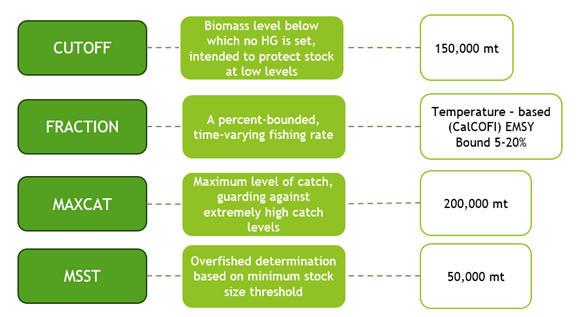
CUTOFF – This is the biomass level below which no HG is set, intended to protect the stock at low biomass levels. The FMP established this level at 150,000 mt. This amount is subtracted from the annual biomass estimate before calculating the applicable HG for the fishing year.
FRACTION – A percent-bounded, time-varying fishing rate based on a temperature-dependent exploitation fraction (EMSY). Aas with EMSY, the Council adopted a revised temperature-recruitment relationship, based on the 3-year running average of the CalCOFI temperature index. FRACTION is the result of that formula but bounded between 5 and 20 percent.
MAXCAT – The maximum harvest level (MAXCAT) of 200,000 mt. While allowable harvest increases with increasing biomass, MAXCAT guards against extremely high catch levels
MSST – The status determination criteria that determines whether the stock is overfished and requires rebuilding
Aspects of these control rules have been reviewed many times since they were originally developed, as outlined in the Table below.
| Fishing Year | Review or Revision | Description | Reference |
| 1998 | Amendment 8 | Revised the FMP for northern anchovy to manage the entire CPS fishery along the West Coast of the United States, including Pacific sardine, northern anchovy, Pacific (chub) mackerel, jack mackerel, and market squid. | 64 FR 69888 |
| 2011 | Amendment 13 | Revised the acceptable biological catch (ABC) relative to overfishing limit (OFL) to include a buffer to account for scientific uncertainty, per new provisions of the reauthorized MSA and the NS 1 guidelines. This buffer is determined annually through a combination of scientific advice from the SSC and a policy determination of the Council. | 76 FR 70362 |
| 2013 | Workshop on Pacific Sardine Management Strategy and Harvest Control Parameters | Reviewed harvest control rule parameters for the Pacific sardine fishery, exploring environmental and stock distribution relationships, and developing a plan for a full management strategy evaluation. | i-coastal-pelagic-species-management-april-2013.pdf |
| 2015–2016 | Workshop on Pacific Sardine Distribution | Reviewed the Distribution parameter in the harvest control rule (HCR) for the northern subpopulation of Pacific sardine, as well as potential alternative means of accounting for the fact that some portion of the U.S. stock is present and subject to harvest outside U.S. waters. | h-1-a-pacific-sardine-distribution-workshop-report.pdf |
| 2016–2017 | Review and Re-evaluation of MSST for CPS Finfish for the U.S. West Coast | Reviewed information on MSST for CPS stocks and analyzed potential alternatives. | e1a_sup_nmfs_rpt_mssts_sept2016bb.pdf |
| 2021–2022 | Amendment 18 | Implemented a Pacific sardine rebuilding plan. | 86 FR 33142 |
| 2025–2026 | Amendment 23 | Revised the Pacific sardine rebuilding plan to implement stock status-based ACLs. | 90 FR 23461 |
| Re-evaluation of the recruits-per-spawner and CalCOFI SST relationship in Pacific sardine | Reviewed the re-calculated correlation between the CalCOFI SST index and the indices of biomass and recruits with updated time series data, and re-examined model selection results and model fit, following the methods from the Pacific Fishery Management Council’s 2013 sardine harvest parameters workshop. | https://doi.org/10.25923/fyn8-pn27 |