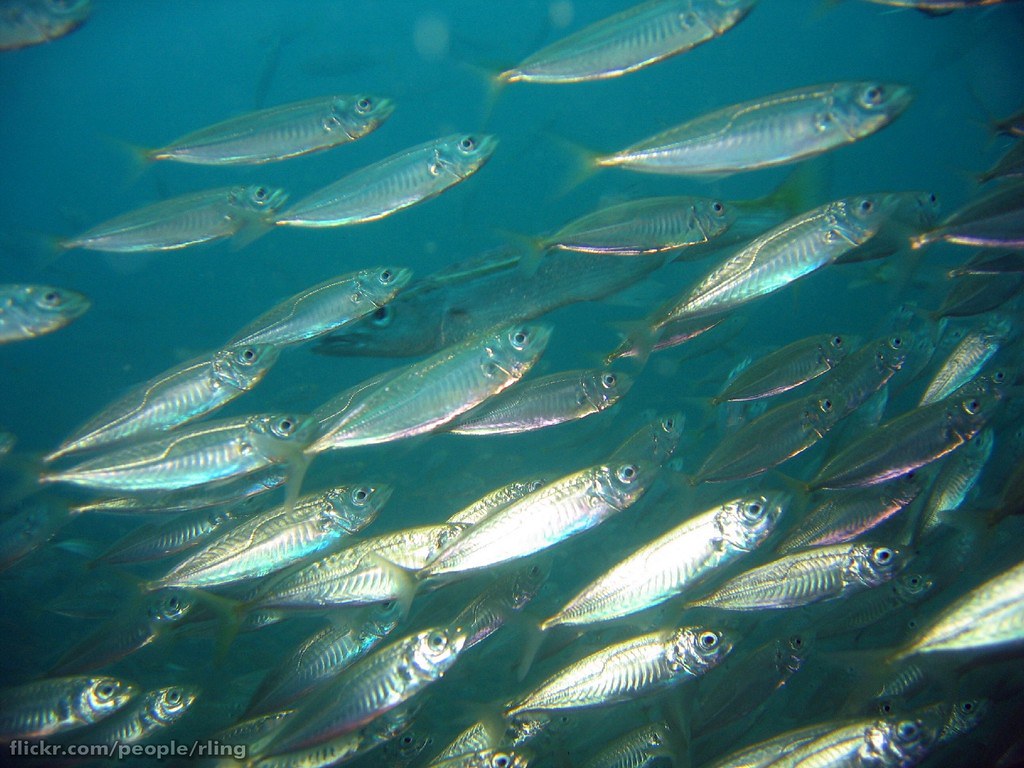
Coastal Pelagic Species: Current Season Management
Under the annual management cycle for coastal pelagic fisheries (CPS), every June a stock assessment and fishery evaluation (SAFE) document is presented to the Council along with the current stock assessment for Pacific mackerel. At the June meeting, the Council adopts a harvest guideline for the Pacific mackerel fishery, which runs from July 1 through June 30. In November, as a supplement to the SAFE document, the current stock assessment for Pacific sardine, is presented to the Council, and the Council adopts a harvest guideline for the January 1 through December 31 sardine fishery.
Market squid, jack mackerel, and northern anchovy are in the “monitored species” category. State regulations in California place gear and effort limits on the market squid fishery. Northern anchovy and jack mackerel catch has been low in recent years. Landings of these species are monitored and should landings increase, the Coastal Pelagic Species Management Team (CPSMT) and the Council may recommend elevating one or both of these species to the active management category for assessment and regulatory considerations.
Pacific sardine
In November 2011, the Council adopted sardine fishery harvest specifications for January 1 – December 31, 2012, including an overfishing limit (OFL) of 154,781 metric tons (mt); an acceptable biological catch (ABC) equal to the annual catch limit (ACL) of 141,289 mt; and an annual catch target/Harvest Guideline (ACT/HG) equal to 109,409 mt. These are based on the biomass estimate of 988,385 mt and the harvest control rule in the Coastal Pelagic Species Fishery Management Plan.
The Council recommended that 3,000 mt of the ACT be set aside for Pacific sardine research activities in 2012, and 9,000 mt of the ACT be set aside in recognition of a Tribal allocation request. This results in an adjusted ACT/HG of 97,409 mt for directed and incidental fishery harvest of Pacific sardine to be allocated seasonally per the existing allocation framework. The Council will review research proposals and consider exempted fishing permits (EFPs) in the spring of 2012 for utilizing the research set-aside in new and continuing Pacific sardine surveys.
The 2012 harvest specifications reflect new fishery management policies designed to prevent overfishing, and contained in Amendment 13 to the Coastal Pelagic Species Fishery Management Plan.
| 2012 Pacific Sardine Harvest Specifications and Management Measures | ||||
| Total | By Seasonal Allocation Period | |||
| ABC/Total Harvest Guideline | 109,409 | Period 1 | Period 2 | Period 3 |
| Research Set-Aside | 3,000 | |||
| Tribal Set-Aside | 9,000 | Jan. 1 – Jun. 30 | Jul. 1 – Sep 14 | Sept. 15 – Dec. 31 |
| Adjusted Harvest Guideline | 97,409 | 34,093 | 38,964 | 24,352 |
| Incidental Fishery Set-Aside | 3,000 | 1,000 | 1,000 | 1,000 |
| Adjusted Directed Fishery Harvest Guideline | 94,409 | 33,093 | 37,964 | 23,352 |
The incidental fishery set-asides are intended to allow CPS fisheries targeting species other than Pacific sardine to continue if a seasonal allocation to the directed fishery is reached or exceeded in any period. Under these circumstances, the Council anticipates that NMFS would close the directed sardine fishery and the fishery would revert to an incidental fishery with an incidental landing allowance of no more that 30 percent Pacific sardine by weight. Under this proposal, the Council anticipates that the National Marine Fisheries Service will take the following inseason automatic actions:
- Any unused seasonal allocation to the directed fishery from Period 1 or Period 2 rolls into the next period’s directed fishery.
- Any overage of a seasonal allocation to the directed fishery from Period 1 or Period 2 is deducted from the next Period’s directed fishery.
- Any unused incidental set-aside from Period 1 or Period 2 rolls into the next period’s directed fishery.
- Any overage of the third period allocation to the direct fishery will be deducted first from the Period 3 management buffer, and secondarily from the Period 3 incidental set-aside.
- If the seasonal allocation to the directed fishery, the incidental set-aside, and the management buffer (where applicable) are reached or exceeded in any period, the retention of Pacific sardine will be prohibited.
- Any set-aside for research that is not included in an EFP will be rolled into the Period 3 directed fishery.
- Any research set-aside attributed to an EFP designed to be conducted prior to September 15, but not utilized, will roll into the Period 3 directed fishery.
Pacific mackerel
The most recent assessment update for Pacific mackerel estimates the current Pacific mackerel biomass to be 282,049 mt. Based on this new assessment and the Pacific mackerel harvest control rule in the Coastal Pelagic Species Fishery Management Plan (FMP), the Council recommends an acceptable biological catch of 55,408 mt and an overall harvest guideline for the 2009-2010 Pacific mackerel fishery of 10,000 mt that includes a 10,000mt set aside for incidental landings should the directed fishery close.
Setting the harvest guideline for the directed fishery substantially below the ABC is recommended as a precautionary measure in response to uncertainty associated with new assessment. The Council also reviewed historic Pacific mackerel landings that have rarely exceeded 20,000 mt over the last 20 years and have averaged approximately 6,000 mt in the last 10 years. Additionally, the Council considered the resiliency of the Pacific mackerel stock and industry reports of increasing Pacific mackerel availability at a time when opportunities for Pacific sardine and market squid are declining. The Council felt that this harvest recommendation is motion is in keeping with landings in recent years while allowing modest growth in the fishery.
Should the directed fishery attain the harvest guideline of 8,000 mt, the Council recommends National Marine Fisheries Service (NMFS) close the directed fishery and establish a 45% incidental catch allowance when Pacific mackerel are landed with other CPS, except that up to 1 mt of Pacific mackerel could be landed without landing any other CPS. Any incidental harvest of Pacific mackerel should be applied against the 2,000 mt set aside for incidental landings.
Full assessments for actively managed CPS stocks including Pacific mackerel typically occur every third year. Uncertainty in the current assessment and a decline in available data led the Council to recommend no assessment in 2010. Rather, the Council recommends next year’s efforts be focused on Pacific mackerel research and data analysis to improve a full Pacific mackerel assessment in 2011.
Market squid
In 2001, legislation transferred the authority for management of the market squid fishery to the California Fish and Game Commission (CFGC). Legislation required that the CFGC adopt a market squid fishery management plan (MSFMP) and regulations to protect and manage the resource. In August and December of 2004, the CFGC adopted the MSFMP, the environmental documentation, and the implementing regulations, which went into effect on March 28, 2005, just prior to the start of the 2005-2006 fishing season on April 1.
The goals of the MSFMP are to provide a framework that will be responsive to environmental and socioeconomic changes and to ensure long-term resource conservation and sustainability. The tools implemented to accomplish these goals include: (1) setting a seasonal catch limit of 107,048 mt (118,000 st) to prevent the fishery from over-expanding, (2) maintaining monitoring programs designed to evaluate the impact of the fishery on the resource, (3) continuing weekend closures that provide for periods of uninterrupted spawning, (4) continuing gear regulations regarding light shields and wattage used to attract squid, (5) establishing a restricted access program that includes provisions for initial entry into the fleet, permit types, permit fees, and permit transferability that produces a moderately productive and specialized fleet, and (6) creating a seabird closure restricting the use of attracting lights for commercial purposes in any waters of the Gulf of the Farallones National Marine Sanctuary. Under this framework, the MSFMP provides the CFGC with specific guidelines for making management decisions.
| ABC | acceptable biological catch |
| CFGC | California Fish & Game Commission |
| CPS | coastal pelagic species |
| CPSMT | Coastal Pelagic Species Management Team |
| EFP | experimental fishing permit |
| FMP | fishery management plan |
| HG | harvest guideline |
| MSFMP | Market Squid Fishery Management Plan |
| MT | metric tons |
| NMFS | National Marine Fisheries Service |
| SAFE | Stock Assessment and Fishery Evaluation (document) |